
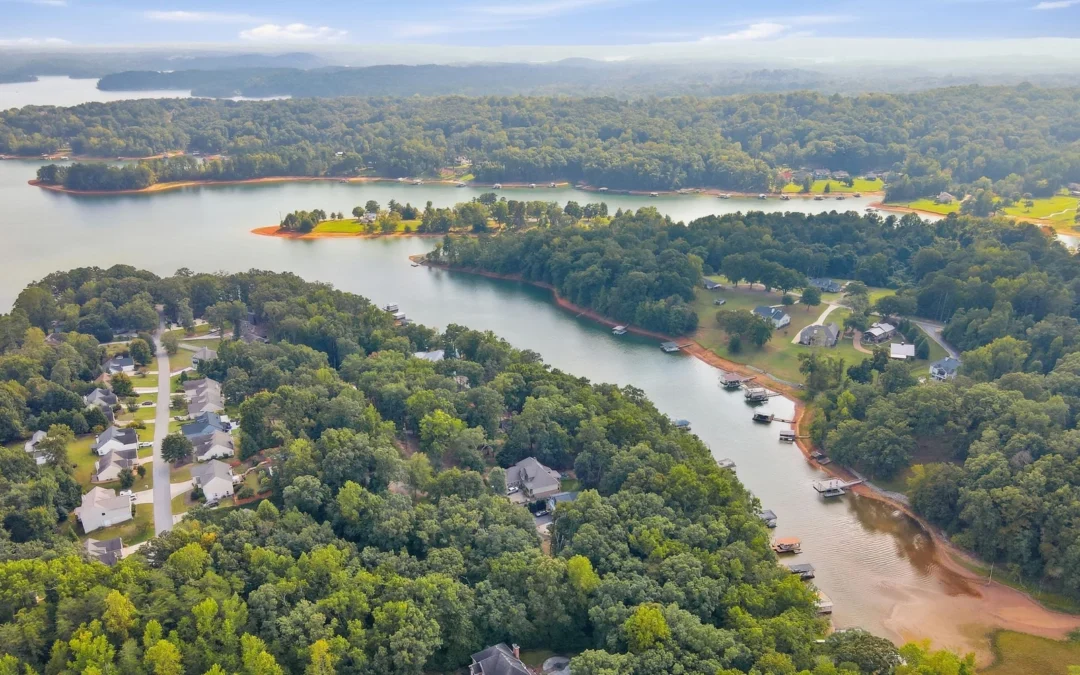
Lake Lanier Water Levels: What Full Pool, Drawdown, and “Deep Water” Mean for Your Dock
Last updated: September 2026
A dock can look terrific on the day you tour a Lake Lanier home. The question is how well it works when the lake is several feet lower. That difference can affect your boat, your lift, and how easily you reach the water.
Here is how to read the lake level, put a dock-depth claim in context, and check a property before you buy.
Key Takeaways
- The Corps’ guide curve generally uses 1,071 feet for summer pool and 1,070 feet for winter pool. The target transitions between them; it is not a promise that the lake will stay there.
- The U.S. Army Corps of Engineers manages Buford Dam for several purposes, and rainfall and inflow also affect the lake level.
- For the same spot on the lake bottom, a one-foot drop in the lake surface means about one foot less water depth. That is why the date and lake level matter when someone quotes a dock depth.
- The Corps reports a record low of 1,050.8 feet in December 2007 and a record high of 1,077.2 feet in April 1964.
- “Deep water” in a listing is a description, not a measurement. Ask for the actual depth at the end of the dock and the lake level on the day it was measured.
What Does “Full Pool” Mean on Lake Lanier?
Full pool is a reference lake-surface elevation on the Corps’ operating guide curve. The lake level reported at Buford Dam gives you a common benchmark, but it does not tell you how deep a particular slip is.
The guide curve generally reaches 1,071 feet in the warmer season and 1,070 feet in winter, with transitions between those targets. Actual levels may be well above or below the curve. Rainfall, drought, and management of the wider river system can move the lake well beyond that one-foot seasonal difference.
Why Lake Lanier Water Levels Change
Lake Lanier is a reservoir created by Buford Dam in the 1950s. The Corps manages it for flood control, power, water supply, navigation, water quality, recreation, and other authorized purposes. Its operating rules consider the broader Apalachicola-Chattahoochee-Flint basin, so conditions downstream can affect releases as well as the water coming into the lake.
Add rainfall, drought, and evaporation, and the lake can sit several feet below full pool for months at a time, often in late summer and fall. The Lake Lanier Association works with the Corps on keeping as much water in the lake as possible and is a good resource on how basin management works.
How Water Levels Affect Your Dock
If a particular slip has 10 feet of water when the lake is at 1,071 feet, a three-foot drop would leave about seven feet at that same spot. This illustration assumes the bottom has not changed and uses 1,071 feet as its reference:
| Lake level (ft) | Below full pool | Approx. water at the slip |
|---|---|---|
| 1,071 | 0 ft | about 10 ft |
| 1,068 | 3 ft | about 7 ft |
| 1,065 | 6 ft | about 4 ft |
| 1,062 | 9 ft | about 1 ft |
Example only: these estimates apply to the same fixed spot over an unchanged lake bottom. If a floating dock is moved, the depth beneath its new position must be measured again.
The same lake-level drop can affect properties very differently. Across the connected lake, the surface generally falls together, but water can retreat much farther across a gently sloping cove than along a steep shoreline. Shallow coves can lose usable boating access sooner, even when water remains beneath the dock. Check both the slip and the entire route to open water; this table is not a guarantee of dock usability or safe boat clearance.
A few things come along with that drop:
- Your ramp can get steeper. Changing water levels can affect the gangway’s slope and the walk to your dock. Plan for ongoing dock maintenance and permitted adjustments.
- Do not assume you can extend the dock to reach deeper water. Check what your permit allows, including dock placement and walkway length, and ask your area Ranger which adjustments or modifications require approval. (More on that in our guide to Lake Lanier dock permits.)
- Severe drought can put docks on dry ground. During the 2007 drought, many docks around the lake ended up sitting on land.
- High water has its own risks. When the lake runs well above full pool, officials have urged owners to cut power to their docks, since submerged electrical connections are dangerous.
Main Channel vs. Coves: Where Depth Holds Up
On Lanier, the main-channel-versus-cove question deserves a closer look. A channel-side dock may offer open views and direct boating access, along with more exposure to wind and wakes. A sheltered cove may feel calmer and can still have excellent depth. The bottom beneath the slip and along your route to open water matters more than the label.
My advice: compare the slip, the route to open water, and the boat you plan to use. Then spend time at the dock on a busy boating day. A beautiful view matters, but so does being comfortable using your dock and getting your boat in and out when the lake is lower.
How to Check Water Depth Before You Buy
- Ask for depth measurements with a date attached. Get the depth at the end of the dock and at each slip, plus the date it was measured. Then look up the lake level for that date on the USGS monitoring location near Buford. A depth reading without the lake level is half a number.
- See it at low water if you can. Lake levels do not follow the calendar perfectly, so compare the actual gauge reading on your tour date with the level shown in any seller photos.
- Look back in time. Historical satellite imagery may help you see past shoreline conditions, though image dates and water levels need to be checked before drawing conclusions.
- Know your boat’s draft and the clearance it needs to operate safely. Check the slip, the lift, and the route out of the cove at a lower lake level.
- Confirm the dock matches the permit. A dock that was moved or modified without approval can create problems at change of ownership. Our dock permit verification guide walks through how to check.
- Build time into your due diligence. An agent who works on Lanier will know which questions to ask and which contract protections to consider.
Selling a Lanier Home? Document Depth Now
If you are thinking about selling, document the depth at each slip and along the route to open water. Record the date, the lake elevation from the gauge, where and how you measured, and a few clear photos. Buyers can then interpret the numbers even if they visit at a different lake level.
Where to Check Lake Lanier’s Water Level Today
Frequently Asked Questions
What is full pool on Lake Lanier?
The Corps’ guide curve generally uses 1,071 feet for summer pool and 1,070 feet for winter pool, with transitions between those targets. The actual lake level changes with conditions.
Why is Lake Lanier low?
Rainfall and inflow, evaporation, and releases through Buford Dam all affect the level. Check current Corps and USGS data before attributing a particular drop to one cause.
What is the lowest Lake Lanier has ever been?
The Corps lists 1,050.8 feet in December 2007 as the record low, about 20 feet below the 1,071-foot summer reference.
Can I extend my dock if the water gets too shallow?
Do not assume an extension will be allowed. Review your Corps shoreline use permit and contact the Ranger for your area before planning modifications. Ask what routine water-level adjustments are already permitted and what would require separate approval.
What does “deep water” mean in a Lake Lanier listing?
It isn’t a standardized measurement. Always ask for the actual depth at the dock and the lake level on the date it was measured.
Where can I check the current Lake Lanier water level?
Check the Corps’ Lake Levels page and USGS monitoring location 02334400 near Buford. Select the reservoir-elevation reading, check its timestamp and reference datum, and remember that lake elevation is not water depth at your dock. Real-time USGS readings are provisional and subject to revision.
Thinking About a Home on the Water?
Water depth and the dock permit deserve a close look before you commit to a lake property. If you want help evaluating a specific dock or finding one that fits your boat and your lifestyle, start with our Lake Lanier waterfront homes with docks, or reach out to our team. For the full buying picture, bookmark the Ultimate Guide to Buying Lake Lanier Real Estate and What No One Tells You About Buying a Home on Lake Lanier.
